The one-person show
One person's talent is covering a gap in your design. On the days they are not there, your guest meets a different property.
Do your scores change depending on who is on shift?
Experience architecture for luxury hotels and restaurants.
Not the building. Your guest's stay.
Request a conversationMost luxury hotels and restaurants do not fail on concept or on talent. They lose coherence somewhere between the vision and the execution.
You pay for that loss every day: in comps and service recovery, in turnover, in a rate that becomes harder to defend, and in guests who do not come back.
Repeated long enough, you stop seeing it from inside. And it almost never appears in your reports.
Some patterns I have seen repeat across very different projects. Do you recognise any of them?
Where is your project today?
One person's talent is covering a gap in your design. On the days they are not there, your guest meets a different property.
Do your scores change depending on who is on shift?
Everything is right and none of it registers. The value is real, but nothing in the experience helps your guest see it. No single department is doing anything wrong.
Do the reviews describe the property you think you run?
People leave a property that works on paper. When what your team is asked for and what it is given do not match, the friction lands on them every day, and the ones who care most are the first to go.
Are the people leaving the ones you most wanted to keep?
Your investment goes to the arrival and the peaks. When the warmth ends with the payment, your guest learns it was part of the price, and a stay that felt personal is remembered as something they bought.
Does your guest leave with a bill, or with an invitation to return?
Your team was trained to follow a set of steps, and they follow them well. Then something happens that the steps do not cover, and they stop, or they invent. They learned the script, not the reason behind it, so they cannot rebuild it when the night goes off plan.
Do you train your team to follow the script, or to understand it?
A soft opening is where real conditions meet the plan, and the adjustments that follow are the work, not a sign of failure. The problem is when they never end, and your opening quietly becomes a permanent state.
Six months in, has the operation settled, or is it still being adjusted?
Do you recognise one of these in your project? Or maybe none of them fits. Nothing is wrong, it works, and you want it to be remembered.
Tell me about yoursThese start before opening day, when they are still easy to change.
Something for everyone. An idea that worked somewhere else, another that impressed someone, another that felt safe. Each one is good. Together, they pull in different directions. A place that tries to fit everyone ends up mattering to no one.
What is the one idea all the others serve?
The finishes, the spaces, the extravagant services. Everything your guest sees says luxury. If the experience does not live up to it, the gap is what they remember. Seen but not felt, luxury is just an expensive stay.
Which of your luxuries would your guest miss if it disappeared?
More options, more touches, more steps. It looks like care. It is the opposite. Every extra step is one more chance to fail, and one more thing your team has to remember. An action without intention is just noise.
What is the intention behind each interaction you have planned?
The concept was designed around the guest. Nobody designed it around the team who delivers it every day. Anyone can carry that for two weeks. The most committed carry it for two months. Then people start to leave.
Will your project succeed thanks to your team, or at their expense?
The same symptom can have several causes. A good solution aimed at the wrong one changes nothing.
Every one of these patterns has the same root: an experience that was never designed as one.
An experience is not a list of services. It is a sequence, and your guest reads it as one continuous thing: how they are met, how a request travels between your departments, what happens when something goes wrong, how they are sent off.
Experience architecture is designing that sequence on purpose, instead of letting it assemble itself. It brings your concept, your space, the timing and the senses together, so that what the guest sees, what your team does and what the guest feels all say the same thing.
Your departments can each run well and still not add up to one experience, unless the seams between them are designed too. And it is built for your team as much as for your guest: a team given a coherent sequence knows what to do when the script runs out.
Your guest does not experience departments. They experience one line.
I design your guest journey with you before the doors open, built around your vision and your project, so the patterns above never start.
The point is simple. What opens should be the concept you planned, not the version your team improvises in the first month.
I go through your property as a guest first, and then follow each moment backwards into the operation that produced it.
That is how you find the exact point where what you intended and what your guest received stop matching, and what is causing it.
If nothing is broken, the same reading shows which moments could make your guest come back. Moments that belong to your brand, and that your team can hold every day.
In both cases, you decide how far I go. I give you realistic options, from a single visit to working alongside your team for months, and you choose the scope.
There is no price list here and nothing ready to buy. What I do for you is shaped for your property, which is why it begins with a conversation and not a proposal.
If we go on, I design the sequence that removes the cause. The aim is not a perfect operation, there is no such thing, but a coherent one: fewer avoidable mistakes, and the unavoidable ones met the same way by everyone. Your team makes it theirs, so it works without me in the room.
I cannot tell you how long the correction takes before I know what is causing it. What I can tell you is that within two weeks of my visit, you have what you need to decide. And once the decision is made, we move.
A few questions I am often asked, so neither of us loses time.
Rubén Menéndez González. I work on my own and take few projects at a time, which is the only way this work is done properly. Esmero Advisory is the company I work through. LinkedIn
Fifteen years in hospitality: my own business first, then Michelin-starred restaurants, luxury hotels and resorts, moving from the kitchen into F&B and guest experience. That is where I learned to read an operation from the inside. Having stood in those roles is what lets me see the whole picture: not only what the guest receives, but everything that has to happen before it. My consulting clients are not named here, for the same reason yours would not be. On a call, I am glad to walk you through how I would approach a situation like yours.
You should not, yet. Trust is earned, not inherited. That is what the first call is for: I listen to your case, I tell you whether I know how to help or whether this is not my ground, I explain how I work, and I answer whatever you want to ask. If you are not convinced at the end of it, you have spent thirty minutes and you leave with more clarity than you had.
Hotels, resorts and restaurants, open or about to open. The common factor is not the format, it is that the experience is meant to justify its price. Occasionally I also take smaller engagements: mystery guest visits, coaching, or reading a concept or an investment before it starts, to find the incoherences while they are still easy to fix. If that is your case, let us talk and I will tell you honestly whether I can help.
My work is to bring coherence, so it would be incoherent to put a price on something I have not designed yet. The first call is free. After it, I send you the cost of the visit. Once the visit is done, you receive the full proposal, and what you paid for the visit is deducted if we go ahead. Every fee is built for the project it belongs to, and you will know each figure before it applies.
Not a number, and not before I know your case. Once I have studied it and we know the causes, each solution comes with its own guarantee, honest and realistic. A number is the consequence, not the deliverable. What I hand you are the tools to improve in your specific case, not a way to dress up your metrics.
It can happen, and you still get the full report. You pay for the judgement, not for a particular result, like any medical test. If I do not find the cause, the report shows what the cause is not. That is also an answer: you stop looking in the wrong place and put your effort where it belongs. If I find something else worth your attention, it is in the report too. If the cause is outside my ground, the report names it and the kind of specialist who can fix it. If that specialist is in my network, I share the report with them, with your permission, so they start with the full picture. What I do not do is invent solutions for causes that do not exist.
Then the visit has a different purpose. There is no cause to find, because there is no problem to fix. I look for what your property could give its guest and does not give yet: the signature moments that would make your guest come back, the sequences worth redesigning, the places where the stay is correct but not memorable. The report shows where they are and how to build them with your team. And if your property already gives everything its concept allows, I will tell you that too.
Yes, I work on my own. On site, I work alongside your team. When a project needs a specific skill, I bring in collaborators from my network, on demand and at specific moments. What does not happen is somebody arriving in my place: I design and supervise the work myself.
Exactly. Almost everything that goes wrong between a property and its guest goes wrong between departments, not inside them. I see the floor with a cook's eyes and the kitchen with a floor's eyes. I know what a request costs on one side and how it looks from the other, which things are easy and which only appear to be, and I can say it to each department in its own language instead of in management's.
I have also been a guest my whole life. For two years I travelled across Southeast Asia as a guest, and helped local owners improve their hospitality projects along the way. That is the other half: knowing which moments actually make a stay memorable, and which only look like they should.
That is the ground I work from. Not a method I read.
I do, but inside a project: when your team needs support on something we have designed together, or with your heads of department, so the standard stays alive without me. What I do not sell is training on its own. Training teaches a team to execute what already exists. If what exists is incoherent, the same problems come back in a few weeks, because the cause was never the team. If the design is sound and training really is what is missing, I will tell you.
If you have reached this page, someone recommended me or you were curious. Either way, there are two ways from here. You can close the page, and nothing is needed from you. Or we can talk. Whatever follows stays between us, from the first conversation to the last report.
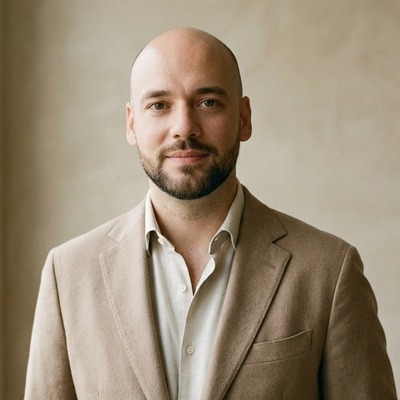
Rubén Menéndez González
Or write to info@esmero.net